


The Town Square (Alun-alun)
During the 16th-century reign of Panembahan Senopati, the alun-alun was a sprawling open square where citizens congregated and where the Mataram royal court announced official proclamations to the public. It also served as the ground where commoners practiced the pepe tradition—sitting under the midday sun to appeal for an audience with the king and voice grievances. What was once a vast open square in the 16th century has now transformed into a densely populated residential neighborhood. True to its historic toponym, it is known as Kampung Alun-alun.
Within Kampung Alun-alun lies an extraordinary social and architectural phenomenon unique to Kotagede known as gang rukunan or jalan rukunan (the pathway of harmony). In 1986, an architectural research team from Universitas Gadjah Mada (UGM) introduced this spatial arrangement to the academic world as "Between Two Gates" (BTG). BTG represents a quintessential residential hallmark of Kotagede: a row of nine authentic Kotagede traditional houses built side by side, flanked at both ends by two gates that serve as the exclusive entry and exit points for this cluster of homes. Each house features a central courtyard that doubles as a communal pathway connecting the homes. Ideally, a traditional Javanese house consists of two primary sections: the northern main living structure called the dalem, and the open-air pavilion known as the pendhapa situated to the south. Between the dalem and pendhapa lies an open courtyard referred to as the longkangan. The residents of these nine homes warmly welcome their neighbors, and even visitors beyond the cluster, to walk through their longkangan and house yards.
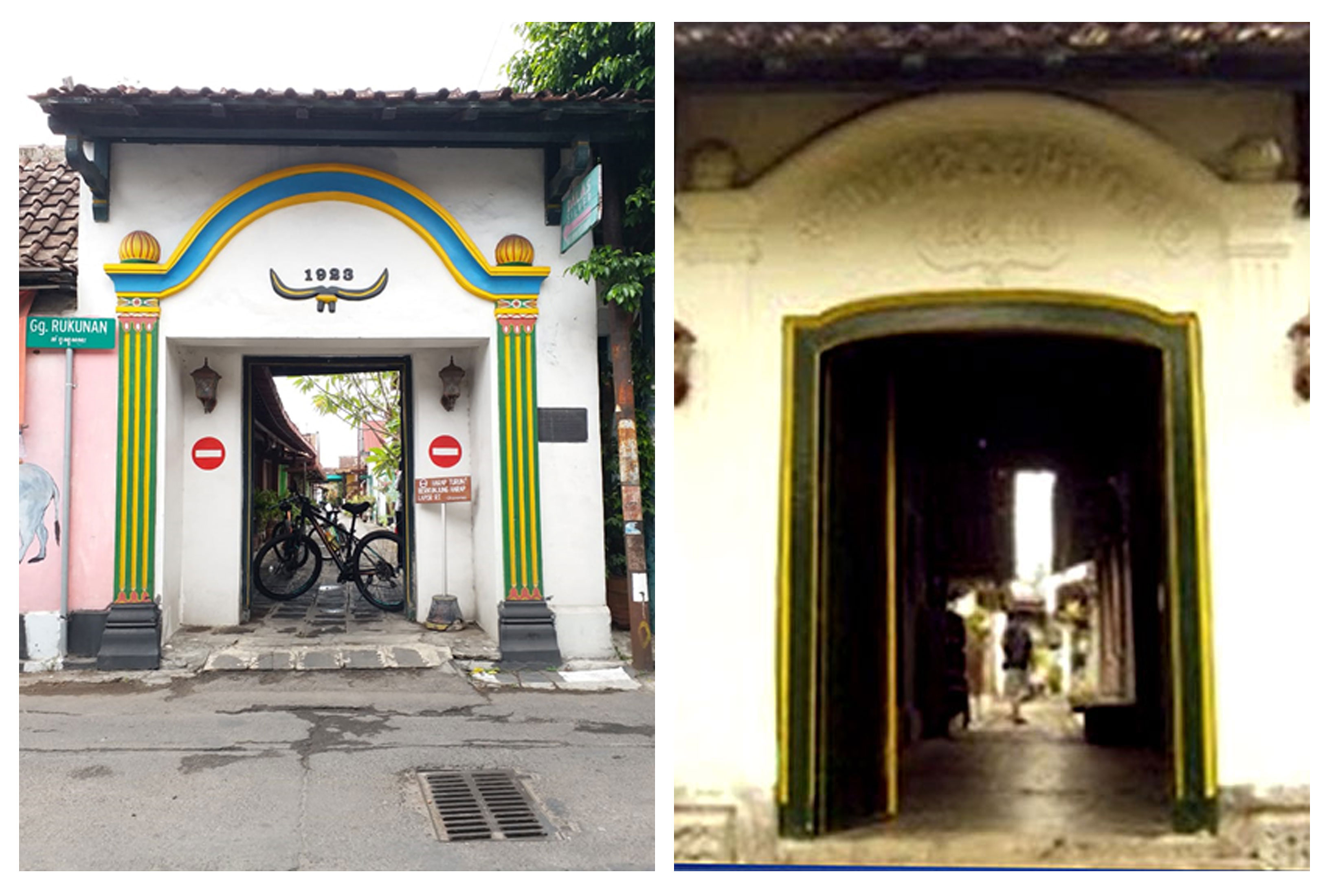
Socio-culturally, BTG or Jalan Rukunan holds profound community and cultural value. Along this pathway of harmony, timeless virtues of unity (kerukunan), communal cooperation (gotong royong), mutual empathy and tolerance (tepa selira), and the generous sharing of personal space with neighbors and visitors are continually nurtured. In other words, Jalan Rukunan represents private property graciously made accessible for public convenience. It can also be described as a spatial heritage reflecting the Javanese life philosophy of sharing and lending a helping hand to fellow human beings, fostering a community that lives in serenity, peace, and harmony (ayem tentrem).
For non-residents passing through Jalan Rukunan at BTG, one can immediately sense the heartfelt benevolence of the homeowners who invite passersby through their private grounds. In a community where individuals consistently experience kindness and hospitality from their neighbors, it nurtures the soul and refines one's character. Noble values are continually instilled in anyone walking through Jalan Rukunan. Whenever someone traversing the pathway encounters a homeowner, friendly greetings and warm exchanges naturally arise; this neighborly communication fosters close social bonds within the community. Such genuine intimacy is often lost in modern urban life, yet it thrives naturally along Jalan Rukunan. This pathway represents a tacit social agreement in urban spatial planning aimed at preserving harmony, familiarity, tolerance, and sharing among neighbors.
Consequently, Jalan Rukunan indirectly educates human behavior: teaching people to enter another's private space with utmost respect, to walk with decorum, to warmly greet anyone they encounter, and to depart peacefully without causing disturbance. Virtues such as mutual greeting and courteous manners flourish naturally through the existence of Jalan Rukunan, reinforcing the harmonious atmosphere of the neighborhood. The principle of "owning, yet willing to share" is arguably the deepest philosophy underpinning Jalan Rukunan. In modern notions of property ownership, private land is often viewed as an exclusive realm that must be strictly separated and cordoned off from others.
Yet in Jalan Rukunan, the community demonstrates an entirely different perspective: "This is my land, but we can share in its daily benefits together." The owner does not relinquish ownership, but willingly shares its functional utility. The neighbor does not own the land, but enjoys the right of way while deeply respecting the owner's prerogatives.
From the interactions between neighbors crossing Jalan Rukunan emerges a social bond built firmly upon trust. Hence, Jalan Rukunan serves as a tangible embodiment of the Javanese proverb: rukun agawe santosa — harmony brings strength and tranquility. In short, Jalan Rukunan illustrates the spirit of mutual cooperation (gotong royong) manifested through residential architecture tailored for the people of Kotagede.
In the midst of modern life that has grown increasingly individualistic, Jalan Rukunan offers an invaluable, timely lesson. It reminds us that a harmonious community does not necessarily require vast physical spaces. What matters most is trust, willingness to share, respect for fellow human beings, and an acute awareness that we all live side by side. Therefore, Jalan Rukunan is far more than an architectural relic of Kotagede.
Jalan Rukunan is an enduring mindset. A mindset asserting that ownership need not mean isolation, that boundaries need not mean division, and that private space can become a bridge connecting community life. This is why Jalan Rukunan deserves to be treasured as one of Kotagede's most precious cultural inheritances. What has been passed down is not merely a physical walkway, but an entire way of life: living together in coexistence, mutual respect, generous sharing, and steadfast harmony.
An important historical distinction must be noted: available historical evidence does not indicate that Jalan Rukunan dates directly back to the 16th-century early Mataram era. While its spatial tradition is deeply linked to Kotagede's ancient settlement customs, the Between Two Gates complex known today is believed to have developed after the Java War (Diponegoro War), as evidenced by the Javanese calendar year 1840 inscribed on one of the eastern gates.
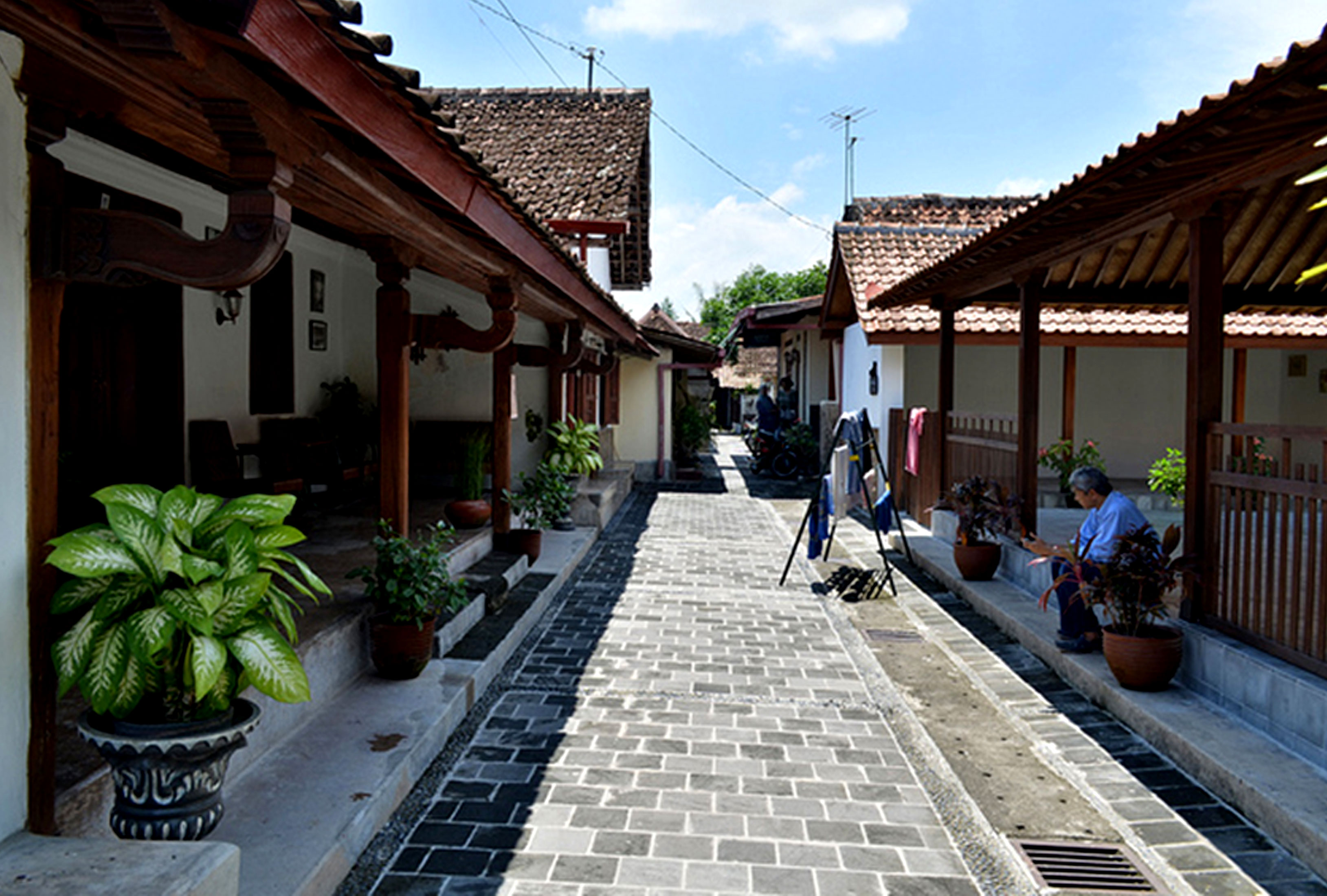
Jalan Rukunan is an enthralling cultural destination in Kotagede, but allow the author to offer a gentle reminder to readers regarding etiquette when visiting. Because Jalan Rukunan is private residential property, visitors are urged to uphold the finest manners and respectful decorum (unggah-ungguh). We hope past incidents are never repeated—such as an occasion a few months ago when two tour buses arrived early in the morning, causing significant noise and disturbance that compelled residents to temporarily close the gates. Through courteous dialogue and thoughtful coordination, the Yogyakarta City Tourism Office resolved the matter, prompting the neighborhood caretakers to reopen the gates for visitors once again.
The author's message for travelers visiting Jalan Rukunan or Between Two Gates is to always remember that this is a private neighborhood, not a public park. Please behave politely when strolling through, smile warmly when crossing paths with homeowners, and greet them whenever possible—at the very least by saying: "Permisi", "Kulo nuwun", or "Spada" (traditional polite greetings). Be sure also to read the information boards placed along the walkway. By observing these considerate practices, your visit to Jalan Rukunan will become a cherished memory, gifting you first-hand experience of the genuine warmth and hospitality of the Javanese residents of Kotagede. May your journey in Kotagede leave you with wonderful, lasting memories.