

Catur Gatra Tunggal: The Twin Banyan Trees of the Royal Mosque Courtyard

THE TWIN BANYAN TREES
As articulated in the Catur Gatra Tunggal spatial philosophy, the Great Mosque of Mataram (Masjid Gedhe Mataram) in Kotagede was established by the king as a sanctuary to guide and educate the people to know God the Almighty, the Creator of all life. The mosque serves as the spiritual epicenter and religious heart of Kotagede society within the harmonious spatial composition of Catur Gatra Tunggal. While earlier articles explored how the Keraton (Palace) and the Alun-alun (Town Square) have now transformed into residential settlements, the Mosque and the Traditional Market retain their exact original locations and historical functions to this day—enduring testaments to the resilience of Islamic Mataram civilization in Kotagede.
The placement of Masjid Gedhe Mataram adjacent to the Royal Palace served as a profound spiritual counterbalance for Panembahan Senopati as the ruler of Kotagede, keeping him ever mindful that above any earthly monarch’s dominion lies the sovereign power of Allah, the Creator of all existence. As the first ruler of Islamic Mataram, he bore the royal title Senopati ing Alaga Sayidin Panatagama Khalifatullah Tanah Jawa—meaning a revered leader, supreme commander on the battlefield, religious guardian, and Islamic leader across Java whose governance was continually anchored in spiritual virtues. In spreading Islam, the mosque functioned as the launching pad for da'wah—the very place where Islamic teachings and outreach were conceived and cultivated, taking root gracefully within the cultural fabric of Javanese society.
Before delving into the main prayer hall of Masjid Gedhe Mataram, it is fitting to first explore its forecourt. Walking south from Kotagede Market along Masjid Besar Street, one is greeted on the west side by perimeter walls and an imposing Paduraksa gate—a roofed portal connecting spatial realms. The Paduraksa gate and its enclosing walls were masterfully constructed using unplastered red brick, showcasing rhythmic brickwork artfully interwoven with white stone reliefs along the ramparts.
Entering the forecourt toward Masjid Gedhe Mataram, a stone walkway leads directly toward the Paduraksa Gate. Flanking this pathway are the neatly aligned residences of the royal courtiers (abdi dalem): courtiers of the Surakarta Sunanate reside north of the gate, while courtiers of the Yogyakarta Sultanate reside to the south. Historically, a magnificent pair of sacred banyan trees stood resolutely on either side of the Paduraksa Gate. The northern tree was named Ringin Sepuh (the elder female banyan), traditionally tended by the Surakarta Kasunanan, while the southern tree was known as Ringin Anom (the younger banyan), under the care of the Yogyakarta Sultanate. Like twin giant Gupala guardians, these two sacred trees watched over the sanctity of the Paduraksa Gate. Within their lush, verdant canopy nested flocks of birds whose melodious songs enriched the serene ambiance welcoming visitors approaching from the east.
Regrettably, in 1990, the northern Ringin Sepuh collapsed and died, and as of September 2026 when this article was penned, it has yet to be replaced. According to oral folklore, Ringin Sepuh was originally planted by Sunan Kalijaga and nurtured by Pangeran Jayaprana. Sunan Kalijaga used this very banyan as a landmark pinpointing the future site of the Islamic Mataram Kingdom, to be founded by Ki Gede Pemanahan and Sutawijaya upon venturing from Pajang into the dense Mentaok forest of Kotagede. Meanwhile, its counterpart—Ringin Anom south of the gate—suffered broken branches in 2022, and in early 2026, the remainder of its trunk also toppled. Nevertheless, we residents of Kotagede continue to hope that the twin banyan trees before the Paduraksa Gate may one day be restored to their full historic glory.
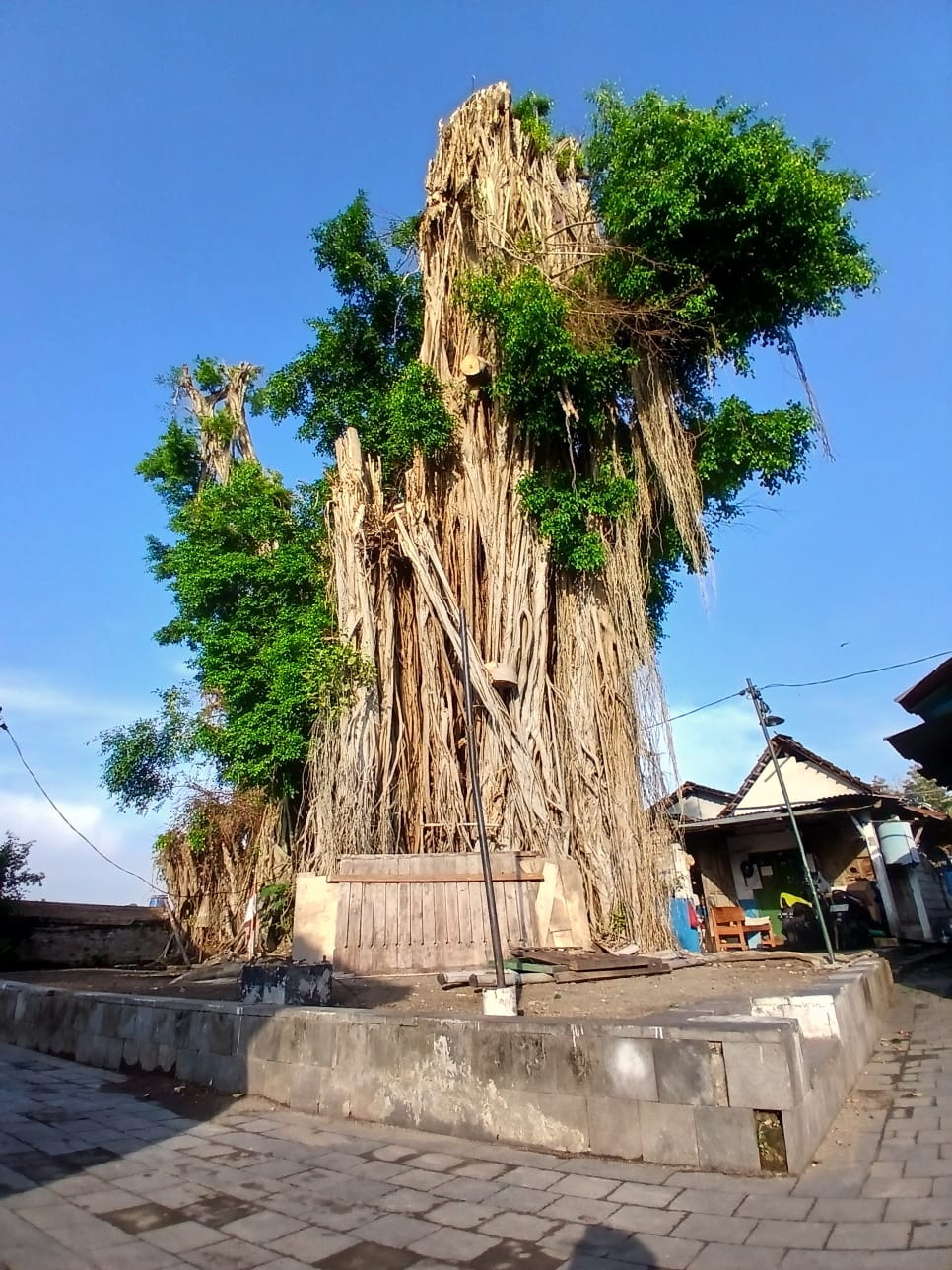
On Sunday, April 17, 2026, the Kotagede Heritage Area Management Board (BPKCB) organized a Focus Group Discussion titled: "Beringin Sepuh: Between Myth, Tradition, and Ecology." Held at the Jagalan Village Hall, the discussion featured notable Kotagede cultural scholar Bapak Achmad Charris Zubair, along with Yayan Hadiyan, S.Hut, M.Sc., and IL.G. Nurtjahyaningsih, Ph.D.—both researchers from the National Research and Innovation Agency (BRIN) specializing in rare plant conservation. A key conclusion from the forum emphasized the vital significance of the twin banyan trees in front of Masjid Gedhe Mataram as enduring symbols of Islamic Mataram's historical existence, underscoring the urgent need for sustainable conservation solutions. Key recommendations included maintaining unpaved soil around the trees without conblock pavement to ensure adequate rainwater infiltration, as well as ensuring that domestic wastewater discharge does not seep into the roots of the banyan trees.