

Catur Gatra Tunggal: The Paduraksa Gate of the Royal Mosque

THE PADURAKSA GATE
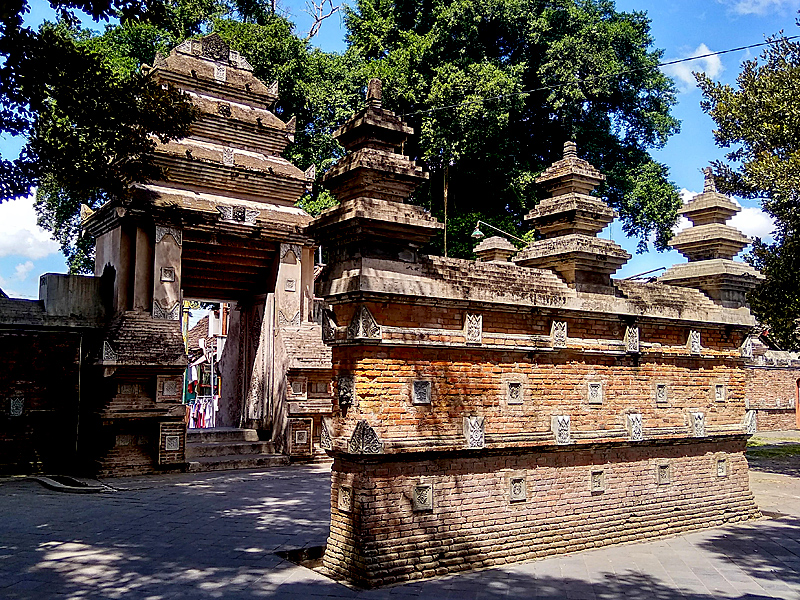
The Paduraksa Gate standing before the Great Mosque of Mataram (Masjid Gedhe Mataram) serves as an architectural marker signifying the transition into the sacred grounds of the mosque. Its form is distinctive: both sides of the gateway are joined overhead by a continuous roof structure. This feature clearly distinguishes it from a candi bentar (split gateway), which consists of two detached halves without any overhead connection. As a roofed portal integrated into the perimeter wall, the Paduraksa gate provides a passage of entry, demarcates boundaries, and signals the spiritual threshold from the outside world into a more sacred realm—namely the mosque courtyard and the royal cemetery complex.
The presence of this gate reflects a profound blend of architectural traditions that flourished within Javanese Islamic culture. Its silhouette evokes pre-Islamic architectural heritage, while its primary function is to serve as the main portal leading into a Muslim place of worship. This graceful acculturation is an essential hallmark of Javanese-Islamic architecture, seamlessly embracing local elements within sacred religious spaces. Far more than a mere doorway, the gate imparts a palpable sense that the visitor is stepping across a threshold into an environment imbued with deep religious devotion and rich history. Masjid Gedhe Mataram and its Paduraksa Gate form an inseparable part of Kotagede’s cultural heritage, linking religious devotion to the historical voyage of the Islamic Mataram Kingdom.
Upon closer inspection, an intricate carving of a Kala (giant head) is visible above the Paduraksa archway. In ancient Hindu tradition, Kala served as a mythical guardian warding off malevolent external influences. For contemporary Muslim readers, this Kala figure also inspires contemplation on the word kala itself, which in the Indonesian and Javanese languages denotes "time"—echoing the opening verse of Surah Al-Asr (103:1), "By time." It serves as a gentle reminder that worldly life is fleeting and finite, while eternity awaits in the hereafter. This interpretation represents a contemporary personal reflection by the author as a Muslim, rather than a strictly historical doctrine.
Stepping through the Paduraksa Gate, one does not immediately gaze upon the inner mosque. Instead, visitors directly face a barrier wall known as a rana or dinding seketeng, which deliberately screens the inner sanctuary from view. Once inside the gate, visitors are guided to turn to the right—reminiscent of Islamic teachings that consistently encourage choosing the right-hand path of righteousness (ashabul maimanah, Surah Al-Balad 90:18). Architecturally, this device is known as a "controlled view." Spatial access is revealed gradually rather than all at once, gently cultivating an aura of reverence and tranquility fitting for a place of worship. The transitional space between the Paduraksa Gate and the seketeng wall can be understood as a threshold guiding worshippers away from worldly distractions and into a tranquil sanctuary of prayer.
Stepping past the corridor formed by the seketeng barrier wall, one's gaze is instantly drawn toward an imposing three-tiered pyramid roof (tajug tumpang tiga) crowned by an elegant mustaka finial. Welcome to Masjid Gedhe Mataram Kotagede. Here, former sectarian divisions dissolve in architectural harmony. As the spiritual pillar of the ancient Catur Gatra Tunggal urban design philosophy, the oldest mosque in Yogyakarta is far more than a conventional house of prayer. It stands as a living testament to how Islam warmly embraced local heritage since the 16th century.