

Catur Gatra Tunggal: The Palace Fortress (Beteng Keraton)

The Palace (Keraton)
In discussing the Keraton (Palace) element within the Catur Gatra Tunggal spatial philosophy, alongside the remnants of the Islamic Mataram royal palace, there are other historical cultural heritage assets in Kampung Dalem. These heritage landmarks include the southern Beteng Cepuri (inner defensive wall) of the Mataram Palace, which still stretches across a considerable length, and the remnants of the northern Beteng Cepuri, of which only a few meters remain, widely known as the breached wall of Raden Rangga (Beteng Jebolan Raden Rangga).
When observed from the material used, the Beteng Cepuri of Kotagede Mataram differs distinctly from the forts of Mataram Kerto and Mataram Plered. The Beteng Cepuri of Kotagede was constructed from limestone (batu gamping). Considering that natural limestone deposits were located far from Kotagede, building this inner fortress must have required immense effort. How did people in the 16th century quarry and cut the limestone, and how were those massive limestone blocks transported from distant quarries all the way to Kotagede to construct the fortress wall? Were the large stones hauled using simple traditional transportation methods to Kotagede, only to be chiseled into rectangular blocks on-site, and then meticulously assembled to enclose the Mataram Palace? This intriguing question serves as a compelling starting point for cultural and historical discussions.
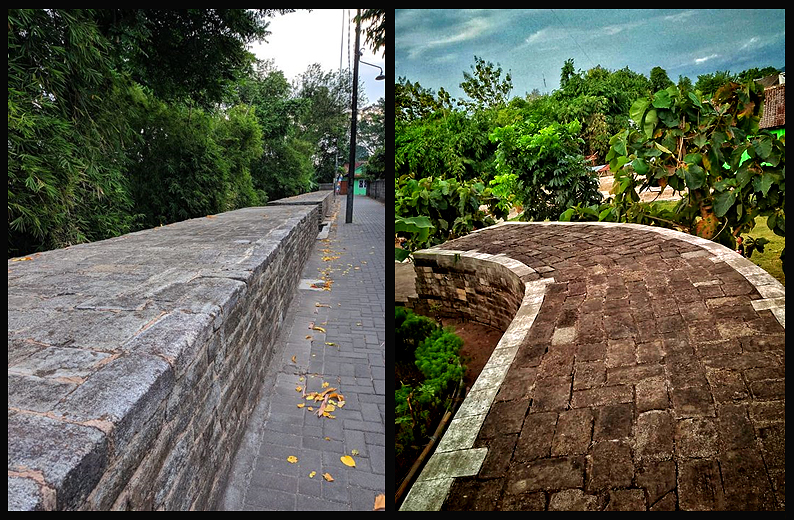
The southern Beteng Cepuri of the Mataram Palace boasts a unique architectural characteristic. In the southeastern corner, the fort wall curves smoothly rather than forming an angular corner as typical forts do. Some interpret this design by noting that when viewed from above (a bird's-eye view), the contour resembles Semar—the revered, eldest Punakawan figure and mentor to the Pandawa knights, who in Javanese culture is revered as the spiritual guardian of the island of Java.
According to community elders, this curved bastion provided guards stationed atop the wall with a significantly broader panoramic view of external surroundings compared to traditional angular walls. Consequently, any enemy movements advancing toward the Mataram Palace could be detected and monitored far earlier and more accurately. As a result, the garrison inside the fortress could thwart incoming assaults much more effectively.
To the south of this fortress wall lies a depression that once served as a reservoir channeling water from the Gajah Wong River to the west of Kotagede, functioning as an aquatic defensive moat (jagang) for the Mataram Palace. Naturally, this defensive moat was supplied continuously by the river west of the royal compound. Tracing the topography confirms that there is indeed lower-lying land surrounding Kotagede, which historically formed this protective water moat system. Unfortunately, the author has yet to discover historical records or oral accounts explaining how the residents of Kotagede exited the city and crossed this defensive moat in those times.
The passage of time and modernization have gradually erased the remnants of the Mataram Palace's defensive moats. The eastern section of the moat, south of Karanglo Street, has now been transformed into school complexes and residential areas; north of Karanglo Street, the former moat has become municipal public apartments (Rusun) for local residents renting before acquiring their own homes. The northern moat has turned into residential neighborhoods, while the western moat near the Gajah Wong River was developed by the Yogyakarta government as employee housing, known as Perumahan Sendok Indah—an acronym derived from Basen and Ledok, referencing an area in Basen that sits noticeably lower than its surroundings.
During the author's college years at the Faculty of Geography, Universitas Gadjah Mada (UGM), we conducted aerial photo interpretation in a Remote Sensing course. Looking at aerial photographs of the Kotagede area, one could observe distinct soil tone differences between the former moat depression and the elevated land above it. From these subtle variations, one could trace the faint outline of the defensive river moat that once encircled Kotagede.
Today, future generations can envision the immense scale of the Mataram Palace during Panembahan Senopati's reign simply by examining the surviving southern Beteng Cepuri and the northern Beteng Cepuri remnants, which now measure only a few meters long. The perimeter between these northern and southern walls marks the historic extent of the Mataram Palace. However, as of August 2026 when this article is written, an urgent issue surrounds the northern Beteng Cepuri cultural heritage site (Benda Cagar Budaya / BCB): the land directly adjacent to the historic wall is currently being offered for sale.
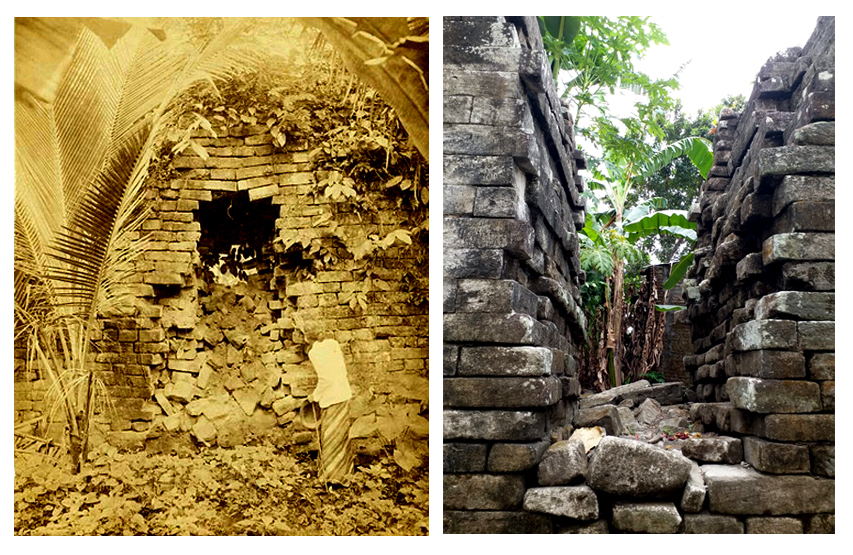
Photo Caption: The black-and-white photo on the left, archived by KITLV around the 1900s, shows a breach in the northern Beteng Cepuri while the upper portion was still intact. In the right-hand photo taken by the author in 2026, the upper section of the wall has collapsed.
According to popular folklore, the breach in the fortress wall occurred through the actions of Raden Rangga, the powerful son of Panembahan Senopati, who struck the wall in anger and broke through it. Another well-known tale recounts that Raden Rangga was massaging his father with such extraordinary strength that Panembahan Senopati, experiencing pain, threw him aside. Because of his supernatural prowess, Raden Rangga's body hurtled through the fortress wall, tearing a hole through it before landing in a village later named Depokan—derived locally from the word "deprok" (to collapse or land heavily), where Raden Rangga landed after being hurled by his father.
As Kotagede residents, we feel deeply concerned if this adjacent land is purchased by someone unconcerned with heritage conservation who proceeds to erect buildings right beside the northern Beteng Cepuri. Regulations permitting construction just one meter away from cultural heritage sites would effectively obscure and engulf the visibility of this historic monument. If the Beteng Cepuri is hidden from view, both younger generations and visiting travelers will lose the tangible reference needed to appreciate the vast scale of the Mataram Palace in the era of Panembahan Senopati. The Kotagede Heritage Area Management Board (BPKCB) has submitted proposals on multiple occasions to both the Yogyakarta City Government and the Special Region of Yogyakarta Provincial Government to safeguard and preserve the northern Beteng Cepuri, yet to date these appeals have not been granted.